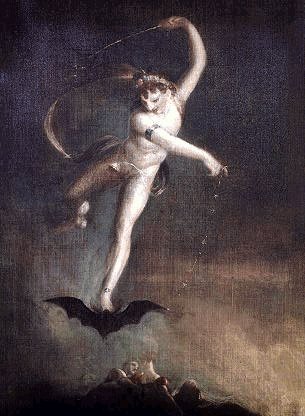
"I return to sentences as a refreshment": Ambience, Consecution, the Open


I began writing what became Beautiful Soul simply as a series of sentences. Very long sentences, as it happens, with enough comma splices to risk revocation of my license as an English professor. A poet works in phrases and above all in lines; sentences are exotic. Nearly as seductive to me are paragraphs, very long paragraphs, the sort of long paragraphs one encounters reading Proust and Adorno and Saramago. Stanzas and strophes have nothing on paragraphs for their elasticity, their infinite yet tensile capacity. "Sentences are not emotional but paragraphs are," says Gertrude Stein. But the problem with sentences and paragraphs is not that they are emotional or unemotional. It's that they say things. And saying things, as I like to remind my writing students, is not what poetry is for.


Mallarmé: "I say: a flower! and, out of the oblivion into which my voice consigns any real shape, as something other than petals known to man, there rises, harmoniously and gently, the ideal flower itself, the one that is absent from all earthly bouquets." Poetic voicing is inseparable from oblivion, from the invisible. But fictive voicing is all too mimetic, all too obliterative of oblivion. It is difficult for fiction to recapture its fundamental rhetoricity; it is difficult not to lapse completely into what John Gardner called "the fictive dream": "the writer forgets the words he has written on the page and sees, instead, his characters moving around their rooms, hunting through cupboards, glancing irritably through their mail, setting mousetraps, loading pistols." The reader forgets too. It's like Eliot's objective correlative, only without the objective part. It's language idealized, all spirit and no letter.

Fictive sentences don't have to work this way. There's Gordon Lish and his theory of "consecution," as explained in a valuable essay by one of his students, Gary Lutz: "a recursive procedure by which one word pursues itself into its successor by discharging something from deep within itself into what follows." The writer reacts to the material properties of constellated words and letters, and proceeds by association from one sentence to the next. In a manner somewhat akin to Ron Silliman's "new sentence," each sentence exists in its own torqued bubble, generative of and yet separate from the sentence that follows it (Lutz calls his article on consecution, "The Sentence Is a Lonely Place"). In a review of Lish's own novel, Peru, David Winters claims that for Lish, "composition cuts across ontology, not only aesthetics" (italics in original).


Winters goes on to compare the "cut" of consecution to, of all things, the clinamen of Lucretius:
"consecution may be less a methodology than a metaphysic; a miraculating agent; an instance of spirit or pneuma submerged in the world. In Lucretius, the force of composition is described as a clinamen—our world is born from a 'swerving of atoms in their fall from heaven. Such is the purpose served by Peru’s perpetual swerving, rhyming and recursion. Each consecutive swerve steps closer toward a total curvature, an arc that delimits the work as a world apart." Each Lishian sentence is its own world, its own monad, in which the universe of the story is contained without being merely represented. It's a mimesis beyond mimesis; the immanent transcendence of representation. The reader encounters the story as a sufficiency, as a world to be explored rather than as something presented. It's an essentially Modernist rather than postmodernist technique.

The Lishian "cut," the Lucretian "swerve": these are comfortably poetic concepts for me, reminiscent as they are of the volta or turn that is central to the operations of verse. The more-than-semantic, physical cut-in-language of the volta is what charges a poem with energy unsupplied by subject matter. Poems cannot completely evade subject matter; words never can. But they come much closer to such evasions, and can entangle a reader in themselves, with a more intensively minimal mimesis than can fiction. And this perhaps is why Yeats can say that poetry makes nothing happen but rather "survives, / A way of happening, a mouth."

Fiction is also a way of happening. And yet to be fiction, something has to happen. To write it, there has to be story. But there's a problem with the Lishian ontological sentence: it's too definitive and determinate. It says things.

A happening is an event. In a recent essay on "the novel as event," Cooper Levey-Baker seems to mean something less eventlike than the scene of events (way of happening): something like architecture or ambient music. Touchstones for his piece include an artwork by Anish Kapoor (creator of Chicago's beloved Bean, aka Cloud Gate) and the collaborations of filmmaker Béla Tarr and novelist László Krasznahorkai. Levey-Baker seems interested in recapturing a particular dimension of Modernism: the challenge to the reader or viewer to encounter the artwork (a film or a novel) so as to make its silence audible, often to the point of discomfort: the unpleasures of boredom. The very long shots without cuts in Tarr's film version of Krasznahorkai's Satantango are the equivalent of the novel's very long sentences, which endlessly defer answers to the audience's questions about what exactly is going on. As at a poetry reading, or leafing through one of Ashbery's longer works, one's mind wanders without ever losing the sense of being in the presence of something, an environment in which the figure-ground relation is rendered ambiguous, if not threatening.

Boredom, Levey-Baker claims, is the last refuge of the avant-garde, the one affect that cannot be recuperated by the entertainment-industrial complex. Long sentences, in their excessiveness, their accumulation and angular momentum, do not have to be boring; but they do tend to be far more open than short sentences. In their attenuated hypotaxis, the extension and interaction of dependent and independent clauses begin to overwrite each other, to introduce a dubiety, room for interpretation.


The past master of this is of course the Master himself, Henry James. Here's a sentence, chosen more or less at random, from The Golden Bowl: " He remembered to have read, as a boy, a wonderful tale by Allan Poe, his prospective wife's countryman—which was a thing to show, by the way, what imagination Americans COULD have: the story of the shipwrecked Gordon Pym, who, drifting in a small boat further toward the North Pole—or was it the South?—than anyone had ever done, found at a given moment before him a thickness of white air that was like a dazzling curtain of light, concealing as darkness conceals, yet of the colour of milk or of snow." This is not unstraightforward; and yet its dart backward toward an impugnation of the American imagination, its dart sideways into Poe, and its ambiguous image of the white mist of others' motivations (concealing the future of our hero) lend an astonishing multiplicity to the sentence's mimesis of what is supposedly happening in Prince Amerigo's mind. James is famous for his psychology, but thanks to his brother William's work we know how close psychology is to philosophy, which is to say the art of disclosing the real. Reality, as William James teaches us, is perspectival. The activity required of the reader of a Jamesian sentence sends her grasping in and through language for a meaning one cannot help but be conscious of creating.

James is also capable of Lishian sentence pairs, as in the following beautifully asymmetrical chiasmus: "He was taken seriously. Lost there in the white mist was the seriousness in them that made them so take him." The reader leaps from stone to stone. The cut is there. But it's the longer sentences that makes James James, and that suggest, for me, a possible fiction, an immanent mimesis, the paragraph-environment, story in language.

Fragment

What a pen can make: lines. The sea sees nothing. The computer heats up, rendering. What was given to Henry James: names. Makes a world. 

They were neither of them saints. Him especially, but also especially, her. But what makes a saint? To have stood for something, and to have suffered for it. Isn't that enough? Isn't that, at least, something?


The artist chooses his constraints: that is his freedom. But the philosopher? Is she not obligated, simply, to the truth? And thus is the least free of all? The philosopher does not invent, even when she does invent: a voice, a character, a concept. The philosopher constructs a discourse, an elaborate machine for unearthing what she discovers in the day or night. She lives in the brilliant aftermath of intuition. 

Moths


It is more important that a proposition be interesting than that it be true.[1]


Begin again. In a new spirit of pragmatism, asking not why I am interested in vital materialism, in modernist poetics, in the dialectic of innocence and experience, in the phenomenological and ecological implications of taking language and the imagination as things that obtain, that exist. Accepting that I am interested in these things, that they are a matter of my temperament, its line or lines of flight. Asking, instead, what this assemblage of interests can do.

The idea has come to me that I want to do now is to saturate every atom. I mean to eliminate all waste, deadness, superfluity: to give the moment whole; whatever it includes.[2]

In my own poetry this assemblage empowers a new practice, a practical poetics to be lived with and explored. Such a poetics undermines the impulse toward the made and returns one’s attention to making. To be always beginning again, with the reader, asking what it is in the moment that poems do.

Say that the moment is a combination of thought; sensation; the voice of the sea.[3]

Poetry is a practice of magic, of incantation, “a matter of disturbance, entrance and passion, rather than abracadabra.”[4] A speech in which the speaker is fully embedded, fully committed. A voice committed to the moment, to creating and being created by the otherness of what the poem includes.

Waste, deadness, come from the inclusion of things that don’t belong to the moment; this appalling narrative business of the realist: getting on from lunch to dinner: it is false, unreal, merely conventional.[5]

It is false, unreal, merely conventional: this business of the realist: how some poetry and much scholarship encases and thwarts experience. In their insistent proprieties they obscure our vision of the actual, what William James called “pure experience.”[6] The actual may be a poem; it may be the western black rhino, declared extinct last week; it may be my daughter; it may be a feeling or a lure for feeling. We lose the actual when we lose the adventure of imagination.

The world of wonders is limited at last to the parent’s will (for will prospers where imagination is thwarted); intellectual appetites become no more than ambitions; curious minds become consciences; love, hatred, affection, and cruelty cease to be responses and become convictions. And the adventure of life becomes a self-improvement course.[7]

We can, in other words, know nothing in advance. The poem lies before us. We are implicated if we write it, if we read it. We are willing subjects in the wrong.

There is a stone chair on a dais. Seeing it is the King’s chair or, even, in some dreamings of this dream, finding myself a lonely king in that chair, there is no one rightly there. A wave of fear seizes me. All things have gone wrong and I am in the wrong. Great doors break from their bars and hinges, and, under pressure, a wall of water floods the cavern.[8]

I am interested in noir. In a noir narrative the protagonist, who is usually some sort of detective, plunges confidently into the heart of an expanding darkness, only to discover that the darkness is inside himself—that he may even be its origin. This is the story of Oedipus and the story of Chinatown. Noir reverses the dialectic of innocence and experience. The experienced detective is undone by his adventure, confronted with his own complicity in evil. He detects himself. A terrible innocence is born. This terrible moment, the moment at the very end of the noir narrative, is ours.

I discover myself on the verge of the usual mistake.[9]

But we can bear in, imagining the darkness rather than willing it.

Medicine can cure the body. But soul, poetry, is capable of living in, longing for, choosing illness. Only the most fanatic researcher upon cancer could share with the poet the concept that cancer is a flower, an adventure, an intrigue with life.[10]

“Ecological politics has a noir form,” Timothy Morton writes. “We start by thinking we can ‘save’ something called ‘the world’ ‘over there,’ but end up realizing that we ourselves are implicated. This is the solution to beautiful soul syndrome: reframing our field of activity as one for which we ourselves are formally responsible, even guilty.”[11] We are or ought to be fanatic cancer researchers, and the cancer is in us. Is us. We are caught up in the Anthropocene. We are caught up in an intrigue with life.

Why admit anything to literature that is not poetry—by which I mean saturated? Is that not my grudge against novelists? that they select nothing?[12]

I have written a novel called Beautiful Soul: An American Elegy. It is a sentimental title for a narrative that struggles to emerge on the other side of sentimentality, as the protagonist, in her struggle with the past that composes her, tries to survive her own innocence of that past. The phrase “beautiful soul” is Hegelian (schöne Seele): “The beautiful soul maintains a split between self and world, an irresolvable chasm created by the call of conscience.... [it] cannot see that the evil it condemns is intrinsic to its existence—indeed, its very form as pure subjectivity is this evil.”[13]

The poets succeeding by simplifying: practically everything is left out.[14]

Poems are not mimetic; they do not represent; they show nothing of states of affairs or states of mind. Poetry is the by-product of what Karen Barad calls “intra-action,” “the mutual constitution of entangled agencies the notion of intra-action recognizes that distinct agencies do not precede, but rather emerge through, their intra-action.”[15] The poet is one agent entangled with innumerable other agents: black rhinos, Congressional Republicans, tornadoes, John Keats, hay fever, words. The particular moment of entanglement is the poet’s experience. The record of that experience is the poem; liable, as Ezra Pound said of The Cantos, to carry “the defects inherent in a record of struggle.”[16]

The poet’s role is not to oppose evil, but to imagine it: what if Shakespeare had opposed Iago, or Dostoyevsky opposed Raskolnikov—the vital thing is that they created Iago and Raskolnikov.[17]

The poem itself is not mimetic but the struggle to produce it is microcosmic; as Whitehead says, “Each task of creation is a social effort, employing the whole universe.” The defects of the poem mark its suffering of incompatible facts. “Insistence on birth at the wrong season is the trick of evil.” Whitehead follows this claim with a gimcrack theodicy, assuring us that “in the advance of the world, particular evil facts are finally transcended.”[18] One can accept this only in the spirit of Kafka’s mordant remark that there is plenty of hope for God, but not for us. Yet what Keats calls “the poetical Character” must participate this hope if is not to be overwhelmed, or to retreat to the guilty noncommitment of the beautiful soul.

...it is not itself—it has no self—it is every thing and nothing—It has no character—it enjoys life and shade; it lives in gusto, be it foul or fair, high or low, rich or poor, mean or elevated—It has as much delight in conceiving an Iago as an Imogen.[19]

Poetic practice is a pragmatism of impure subjectivity. The poem’s I is embedded in, produces, and is produced by what it sees. “Environment” does not exist. There is a vibration and an overlapping and a revision. The poem ends, but the adventure does not. If the adventurer encounters evil, he tarries with it and becomes it for a while. “This thing of darkness I / Acknowledge mine.”[20] That is his obedience to the struggle.

A Poet is the most unpoetical of any thing in existence; because he has no Identity—he is continually in for—and filling some other Body—The Sun, the Moon, the Sea and Men and Women who are creatures of impulse are poetical and have about them an unchangeable attribute—the poet has none; no identity—he is certainly the most unpoetical of all God’s Creatures.[21]

Keats is wrong about the unchangeable attributes of things, since all things are themselves entangled and intra-acting agents. He is right that a poet is willing to enter consciously and of his own free will into the contract of intra-action that binds the rest of us all unwilling, since we are blind to it. That blindness is what makes us poetical creatures of impulse. The poet’s vision makes blindness palpable. What Duncan called, “a little endarkenment.”[22]

I want to put practically everything in: yet to saturate. That is what I want to do in “The Moths.” It must include nonsense fact, sordidity: but made transparent.[23]

Moths are nocturnal insects, except when they are not. There is nothing so strange nor seemingly nonsensical as the luna moth, which molts five times in caterpillar form, eating the leaves of black walnut trees, until finally cocooning and emerging with a wingspan of four and a half inches. The luna moth has no mouth; its career as a gourmand is done. It lives for about a week, flying only by night (unlike the diurnal sphinx moth, the infant moth, the Panamanian tiger moth), the females releasing a chemical that attracts the males to mate with them. Then they lay several hundred eggs, and then they die. Moths are very common, except when they are not. Luna moths are endangered in many areas due to pollution from herbicides and insectisides, as well as habitat loss. Is this saturated? Is this transparent? Is the luna moth, selected for the purposes of this essay very nearly at random, something with which I am entangled in 2013, on the November night after a day of unseasonable warmth and torrential rain, during which at least seventy-seven tornadoes caused five reported deaths and untold property damage in the state of Illinois where I live? The lives of moths are fantastically brief. Does this writing bear the defects of a record of my struggle to imagine an order that is not an illusion or bad faith but the order of intra-action, of noir, of innocence?

For she stood upon the threshold of an art where she was to take her place with Ezra Pound and William Carlos Williams in the adventure of the higher imagination, in the full risk of the poem in which divine, human, and animal orders must be revealed.[24]

The lives of moths are fantastically brief.

Watching him, it seemed as if a fibre, very thin but pure, of the enormous energy of the world had been thrust into his frail and diminutive body.[25]

Innocence survives experience, through experience. The innocence of the moth in its mouthless struggle for life. Of the poem.

Again, somehow, one saw life, a pure bead.[26]


[1] Alfred North Whitehead, Adventures of Ideas, pg. 244.
[2] Virginia Woolf, diary entry of 28 September 1928.
[3] Woolf, op. cit.
[4] Robin Blaser quoted in Lisa Jarnot, Robert Duncan: The Ambassador from Venus, pg. 165.
[5] Woolf, op. cit.
[6] William James, “Does ‘Consciousness’ Exist?” in Essays in Radical Empiricism, pg. 4.
[7] Robert Duncan, “Pages from a Notebook,” A Selected Prose, pg. 16.
[8] Duncan, The H.D. Book, pg. 151.
[9] Walt Whitman, Leaves of Grass (1855).
[10] Duncan, “Pages from a Notebook,” A Selected Prose, pg. 15.
[11] Morton, Ecology without Nature, pg. 187.
[12] Woolf, op. cit.
[13] Morton, pg. 118.
[14] Woolf, op. cit.
[15] Barad, Meeting the Universe Halfway, pg. 33.
[16] Pound, Guide to Kulchur, pg. 135.
[17] Duncan, The Letters of Robert Duncan and Denise Levertov, pg. 669.
[18] Whitehead, Process and Reality, pg. 223.
[19] John Keats, Selected Letters, pgs. 147-148
[20] Shakespeare, The Tempest, 5.1.
[21] Keats, pg. 148.
[22] C.f. Stephen Collis and Graham Lyons, eds., Reading Duncan Reading: Robert Duncan and the Poetics of Derivation, pg. 64.
[23] Woolf, op. cit.
[24] Duncan, The H.D. Book, pg. 210.
[25] Woolf, “The Death of the Moth,” The Death of the Moth and Other Essays, pg. 4.
[26] Ibid, pg. 6.


From an old notebook

The camera preserves looking--the life of the poem.

Can't expel the image without an image
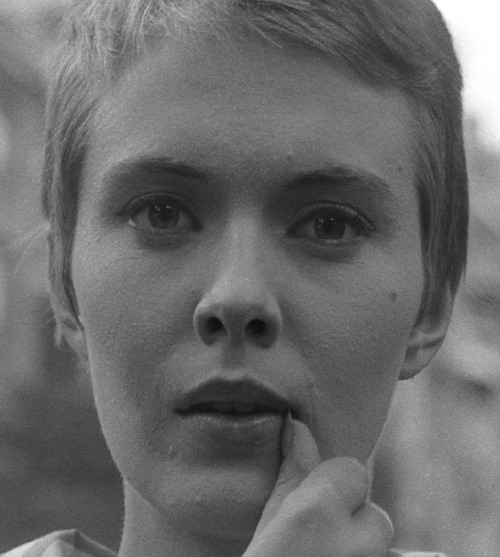
terror face
Streaked the face and the face's frame 
Soot on the lens, incurved eye
Lips parted the teeth rendered
White and black open to be torn
The me of it the late-night regarder
Alone in the house with vintage paranoia
Letter by letter I seek the image
Unconveyed by the phrase "lidless eye"
Unable to flinch
In the face of that
Unable to flinch
Blow to the face

Blunt instrument the eye cannot choose but accept

*

Great fucking title for a book:

SEASON ONE

*

My daughter materializes time for me in a new way: she grows so rapidly that I too must, it seems, be growing as rapidly, or anyway changing, aging: as she discovers language I discover language; as she staggers on suddenly overlong legs so do I stagger. Except I'm used to it, I scarcely notice my own becoming, I think I'm standing still. But time has me in its savage grip for sure. It flourishes us both for now, but a tipping point will come and no doubt sooner than I expect. Or sooner than I'll realize. 

*

Guy at cafe talking about Cleveland as a place that "if you live there, you have a reason for living there"; mentions DFW's novel about it (Broom of the System?) and says that Joyce would have written about Cleveland both as Midwestern oasis and also as a backward and venal place. 

*

A.R. Ammons: "you sit there discussing the theory / of poetry as if you were saved: / meanwhile, a big-mouthed cock / is creeping up on your ass" like "Lawrence's snake"

Ammons: 

carefully fail
at every
task except
the highest

only the essential is material
only the material is essential 

*

Adjustment to the film based on the anticipated desires of the "world audience."

From the distant square oompah music, fat froggy tones of horns, kettle drums, accordions taking the air. 

We haven't lost, I said. We've won. Roche is finished. DeGaulle is finished. The unions are getting everything they've asked for.
The why does it feel like losing?
The victory rally. The thousands of shining faces, floating in a sea of banners, slogans, lights. The man of the hour, the bearer of our hopes, raising his hands to receive our silence. The silence before he speaks goes on and on. Stretched out on the ecstatic rack of time, we, breathless, hearing only each other's stillness, are listening, leaning, hand in spontaneous hand. His lips are parted. A shout that will not be. 
Let me live here ever. 

*

shiver   overcharged
by narrative
bootblacks.   mistress quicklys
overwrought    by night
streaming video from subcontinents
overreaching.   overt hands
fingertips flying up to brush
metal seams of a hull
dark down there
& breathless.    mutineers
parts of the whole
satelite whirligigs   sedan chairs carried
into the muck of speech

*

The goat's colored footsteps

*

Outbound 1/26/10

Flatiron sky flies in wedges
"my iron lung"
Front to back two ladies
Speaking Spanish por que
A flag hovers to my left
Over Evanston's hotel de ville
And where does the gravel on top of shelter roofs come from

Fighting about nothing you
Sleep well all night
Gym bag between my feet
Like an offering

Health care's dead
It's alive!

Little dogs walk
Their feet can't keep up with 'em
Benadette Mayer writes her couplets
At midnight

As I staple together
Ends of the working
Day

*

Rust-red pigeon
What's in it for you

Hey everybody!
Let's go ahead and pathologize
The last several months
Count weeks
And have a few beers

*

The black relic hung
Something to savor
The black relic hung
Crossroads of the years
The black relic hung
Forgotten LP
The black relic hung

*

shoes make broken glass OK


ARK and angels

Just back from reading with Norman Finkelstein at the Green Lantern Gallery / Corpse Space in Wicker Park, in which I tested out a manuscript-in-progress with the working title Hannah and the Master. It's extremely loosely based on the Martin Heidegger-Hannah Arendt romance and I can't tell at this stage whether it's poetry, fiction, a very strange essay, or perhaps a play. It went over well, but that's not what I wanted to remark on--I wanted to remark on this:


Yep--a hot-off-the-presses copy of the new edition of Ronald Johnson's ARK, straight from the hands of editor Peter O'Leary. It has page numbers! And an utterly gorgeous monochrome design. And it has been sensibly given the low low price of $17.95, so that there's simply no excuse not to buy a copy, and copies for all your friends, and to assign it to your students.

Also worth remarking is this:


That's a copy of Joel Felix's new book Limbs of the Apple Tree Never Die, the first release from Peter's new small press Verge Books. It looks exquisite and of a piece with Peter's numinous sensibility. Here's a poem from the book:

Least Wind

1

in least wind
yarrow stalks
dippin sticks
for ages a rain
O drum frog


2

era is ova
drew the tea clear
air then air
two scale trees and wet hair
lick your face


In other news, I am reading all the Alfred North Whitehead I can get my hands on. And am sifting the interwebs for cover ideas for my novel. And teaching Milton and Woolf. Woof.

This Is Jim Rockford


I've made my debut as a TV critic with an essay on how The Rockford Files got me through my fortieth birthday over at Press Play, a new Indiewire blog devoted to TV and film criticism. Check it out.

And if you're interested, here are some older posts on cinema and the cinematic:

Paris Notebook (June 2012)


June 3. Much dirtier and less glamorous than I remember: my heart is not opened. Part of the problem is simple jet lag--plus the fact that I was just "here"--in Europe. German phrases leap to my lips as often as French ones--I am even taken for a German at a kebab shop and offered a "Danke schon" upon departing. Plus my allergies. But Paris--Paris is somehow not yet Paris to me, and I find myself, astoundingly, comparing it unfavorably to Chicago! Could it be that was first impressed me ten years ago was the sheer urbanity of the place--and now that I'm a city-dweller the novelty is gone? A sense of all I'm experiencing being already in the past. The next big project will not begin here. So I am a tourist, looking for what I expected to find. Also, it's unbelievably expensive.


Lunch at a tourist trap across from the Pont des Arts--too hungry to search for something more "authentic," which would be even more expensive. Even a bad French restaurant is good. I do like how the couple on my left has brought their little scruffy dog inside with them and no one objects. The middle-aged American guy says, "Can I get a steak and a glass of red wine?" I'm no different.

I've had better soupe a l'oignon in Chicago. In Evanston, even.

They break a lot of glassware in this place.

Ineffable faint disappointment yet I'm hardly displeased to be her. It's only that Paris no longer nourishes my sense of the ideal--it's just a city whose best days are behind it. Something I didn't feel in Berlin.

The American with the steak is actually Australian.

L'Ecole des Beaux-Arts: entrance on Quai Malaquais. Two fish-backed gray marble columns. Stairs to a great hall in front with dirty glass arcade-style roof.  Obscure panels of classical figures overlook le grand salle where a student exhibition is taking place. A barefoot young woman in a black top and long black skirt conducts an ecstatic dance to the dissonant scrapes of an upright bass.


The cellist, a young man in a dark jacket, bearded and bespectacled, wears a hungry stare. How intimate--the dancer is just a few feet from me. And I must follow her body in motion, or look away. She gets high, then way down low, never quite collapsing. Her long, dirty feet! "At Henry's bier let some thing fall out well..."

A placard: "Programme de recherche La Seine."

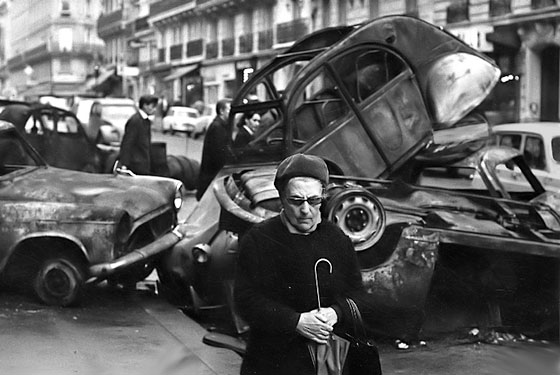
In the back courtyard a man in a Spider-Man costume saunters by. Cops, les flics, barricades. An enormous party is apparently being prepared. A wedding?

After work I would follow the steep narrow channel of Rue Bonaparte to the B. Saint-Germain, and from there the tide of young humanity bore me irresistibly to the Sorbonne. Seeming sneer under the bust of Poussin that guarded the entrance to the courtyard. My bulk sailing as if before my I down the strip of sidewalk encouraging those ahead of me to step into the street to avoid a collision. My native diffidence was impossible to sustain. Gigantic and alone, a head taller than the matchstick-sized Parisians, I could only be covered by a tide as deep as the Events themselves. Ever since and after my eye has ceased to matter.

And have Ruth recall "filthy Paris." Alluring cesspool of generation. Horror of copulation: the Old Coutnry with the New.

I met her on the bridge from the Ile de la Cité walking fast. Are you coming from the Cathedral?
- No.
- Charles is out. I thought perhaps we could get dinner.
- Memorials aren't about remembering!
- No?
- They build the memorial so that they can forget. It's only grass and stone.


- If you're not hungry..
- Of course I'm fucking hungry.
She reached up to me with both arms extended like a child asking to be picked up, and almost involuntarily I stooped to her, bent my face toward hers. She kissed me once, fast and dry: I felt the webbed texture of her lips.
- Let's go, she said.

Filthy Paris, with its best days behind it, the days of the world.

June 4. Another fortuitious performance at the Centre Pompidou, a woman plays cello for a group of schoolchildren sitting before an enormous canvas of Cy Twombly's on which I read the words, "Achilles Mourning the Death of Patroclus."


In the room and corridors of the Sorbonne, the Ecole des Beaux-Arts, the Opera, in houses and flats, the students sat or squatted in great teeming hordes, clusters, groupuscules, adhered to one another by media of sweat and smoke and endless talk. The tiger paced his cage. Black strips cover the eyes of the police, the legislators, the fearful mothers. We walked everywhere, with linked arms, foregoing trains, the Metro, the pastoral of the automobile. We sang. We all but sang.


Every artwork without exception refers first and foremost to our anatomy.

Two Scythes by I.H. Finlay. One bears the legend: "French Revolution, n.: A pastoral with scythes." The other: "Revolution, n.: A continuation of pastoral by other means." Written on green card: "For the best of the Jacobins the Revolution was intended as a pastoral whose Virgil was Rousseau." Also: "Three Parties in the Convention: The Mountain, the Plain, the Ravine."


Incommensurable gap between those artists who believe in "depth" and those who don't. The abyss (or shapelessness) peered into by Pollock in one of last paintings, "In the Deep" (or some such title).

Always moved by hints of process--the fragment, the sketch. The pencil lines visible through the painted volumes of a woman's head.

The windows: intrinsic mystery that plays with our desire to see.


Line and color: so often these were enough for Matisse.

The young American guy on the Metro explaining the plot of Inception to two middle-aged women, at exhaustive length.


Bach's Mass in B Minor at Salle Pleyel. The music of the Mass expresses a fervent hope--becomes in the glory of voices what it scales after. Credo: in music itself, the only resurrection.

Pairing voices with instruments: a tenor with a flute, a bass with an English (French?) horn, each following the theme of the other. To heighten the expression of the words? Or to gesture at a higher form of speaking? Zukofsky's integral.


June 5. As I emerge from my building a middle-aged black man with a receding hairline, wearing a blue checked jacket, carrying a canvas in his hand--it appears to be a rather indifferent painting of a seascape. He holds it up to someone sitting in the passenger seat of a small white man and begins to explain or sell the painting.

Je parle francais, mais je ne comprends pas francais.

People still smoke here, but not as many as I remember.


Charles Fourier's tomb at the Cimeterie de Montmartre, whose walls I can see from my apartment.
The cemeteries here are more integrated than I expected: a fair number of Jewish graves, some of which allude specifically to the Holocaust and anti-semitism. One sees also the occasional historical placard while walking around:

I note that the students were deported for being born Jews. To emphasize their innocence? Or their Frenchness?

To the east of the cemetery past Rue de Caulaincourt toward Sacre Coeur things get more fahsionable in a hurry. Rue des Abbesses a very cute little high street. Coq au vin just inside the door of a cafe with doors flung wide to the streaming sunny late morning.

Maturity comes with the discovery of limitation. That is the real morning Olson (a late bloomer) speaks of: the work of methodology, how to use oneself and on what. Since the end is imaginable--since one's powers are not, after all, unlimited.

My Paris can't be that younger man's Paris. It's a city. Like anywhere for me, it points inward. I'm perhaps not putting enough into it.

Lumiere. Licht.


June 6. Middle-aged bourgeois in a gray suit and blue tie, a briefcase in one hand an a ukulele case in the other.

Jeu de Paume, Rosa Barba exhibition. Mute, staring. "Wrapped in plastic." Where a spine should e, a cut. The actual sublime, refers us to a text. Floyd, Jermaine. Too many voices. Too many choices. Under the rose with an extra R. The film flickers, cut.

Laurent Grasso's Uraniborg: "spaces of uncertainty or doubt aroused by any conjecture."

Being is more terrible than non-being. As Prometheus shows.

The sea is not the desert. The sea is bountiful. Even when it is a desert to the eye, even while it parches the shipwrecked mariner, the idea of the sea--its secret world of multitudinous life--consoles by what it conceals. Cyclops hammering at the surface of the sea, trying to break through. No-man's mocking laughter.

The most desolate of spaces yet ineluctably refer to the hand of man. To the vulnerable throat, channel of his life.

Les Oiseaux--immense flocks of starlings collecting and decoalescing in shapes and patterns over the Vatican, as though demonstrating some immutable law. They look like the smoke monster from Lost.

The Hungarian-Jewish photographer Ava Besnyö, 21 years old, herself photographed seated on a bed hugging her knees alone at the center of

The composition of an immense space.

Another provocative photo of the young woman shot from below, her expression defiant, hands clasped behind her head so that her elbows are thrust out, revelaing double lustrous patches of hair beneath her armpits. The image of M.

June 7. Conference and conferees. On the left foot. Again that sense of speaking the language without really grasping it.


What I miss in these critiques is Duncan's consciousness of the enemy within. Innovative writing gets fossilized in advance, foreclosed.

But is "reality" so purely a social category? This question of "magnetism" that Christina Milletti talks about.

Easy to throw around words like "fascism." But we are our own fascists--we have fully internalized fascism.

Markets, however, area always about competing narratives--supply vs. demand.

Metafiction: the pathos of conscious investment or cathexis in a narrative--the drama of self-fashioning (Hedwig and the Angry Inch as an example).

If we are Americans or Europeans we participate this reality. We all write it.

The  moment one suspends disbelief: chooses to believe, to go along for the ride--an exquisite unnarrativized moment that can only be re-lived.

Narrative as a simple machine incapable of dealing with the sheer volume of available information. Versus the manifold capacities of rhetoric.

Breakdown now of even secularized theology: the expectation of the integrity of the deal.

Truth-seeking through a manifestly alternative, minority system (Duncan's theosophy, etc.) perhaps opens up the most maximal fields--including fields of the self--to critique and transparency.

Rhetoric versus mimesis. Persuasion by other means?

Rob Halpern: Perec's early essay, "For a Realist Literature." [C.f. "The *Nouveau Roman* and the Refusal of the Real."]

June 8. Panel, "Architectures of Absence."Absenting oneself to permit other entities to enter. Amaranth Ravva: "We can imagine what we've covered up with our life." Leah Souffrant: "The effort of attention is more important than its object."

"IF you are a spam filter, you're just like, 'I don't get poetry.'"

June 9. Musée Carnavalet. A little astonished to discover that the Revolutionary Committee of Public Safety had its own stationery.

Lance Olsen: All literature is now too complex for the market. Is an excess of lyricism, of attention to the sentence, enough to be "experimental"? Is it excess itself--of signification or its absence?

Exterior. Exterior.

June 10. Harry Mathews. "The Dialect of the Tribe," a story dedicated to Perec.


Homage to Perec's Bartlebooth. A story about translation and the (I presume) fictional language of a New Guinea tribe that is untranslatable because it's a process, not a vehicle for content. The phatic, the mere presence of the communicative. Quotes Gaddis: "Having an unfinished novel in your house is like having a sick man."

"But how do you construct a novel?" The need for more mathematically advanced Oulipian techniques.

Problem of Oulipo-produced work: the method overdetermines the critical response. (The potentielle more significant than the littérature.) There's also "Canada Dry": a work that pretends to have a procedure but doesn't. (Roubaud.)

Mathews: "I'm a serious romantic writer."

You saw her alive, less alive, still less alive. You saw it: the degree zero of her living. Then you stepped out of it, went for a walk, went to the library. Between the doorway and the card catalog you got the call. Then she was not alive. You went home to see: a corpse. What you missed: the unalive, the last moment, the final breath. Clinamen of her body abandoned in the bed. She's gone, but you did not see her leave, and so it persists, all the remaining minutes of your life: a doubt.

Coover and Mathews in dialogue. Coover: what holds it together beyond the constraint--voice? Mathews: No, voice comes after, in rewriting.

Two beautiful French words: passé composé.


Gerard Richter at the Pompidou: intensive dialectic of his painting. A 1968 canvas, Bunt auf Grau, has a creamy smooth undulant gray background and reddish impasto pink spattered on top. Two layers of technique married in space.

Curious boundary of illusion or spatial point of disbelief--suspension: when you locate on a illusionistic canvas (a seascape) the mark of the paint. The line of the horizon is a line.

Remarkable echo of Titian's Annunciation. Quotes the painting without mocking it, falls short of the original but is not itself degraded or degrading.

Abstract jungle of greens, yellows, oranges, with a pale red arrow gesturing upward on the right and a thick horizontal slash of darker red on the left as a kind of sibling.

There is a kind of reference to natural forms in the big abstracts, but no gestures toward naturalism.

Force: volume: color: line. 1987's large Abstract Painting: a durably joyful sense of release.

Ghostly horizon, sky and sea in a deep blue abstract. Title: Forest (3), 1990.

Abstracts always present surface forms, but very rarely the illusion of perspective or depth, or even of planes.

It must take enormous confidence to move toward the aleatory abstract from a figurative or lyrical abstract mode.

Destruction is not erasure.

Abstraction --> reality
Landscape --> nostalgia

"The landscapes are a type of yearning... The abstract works are my presence, my reality, my problems... The abstraction is more real, the other more like a dream." Gerard Richter in 1986.

Six monumental fucking canvases inspired by John Cage for the 2007 Venie Biennale. Did I see them there?

A series of mother-and-child paintings on the wall opposite portraits of his uncle Horst, a Nazi, and his aunt Marianne, euthanized for her mental disability.

"The Forest."


My Poet's Novel

"Now, Ariel, rescue me from police and all that kind of thing." (Wallace Stevens)

Eileen Myles, poet.
For quite a while now Laynie Browne has been doing a fascinating series on the phenomenon of the poet's novel over at Jacket2, something I had at one time contemplated doing myself. She has written about or interviewed a panoply of poets who have engaged the novel form in various ways: Alice Notley (who when I asked her about novels, said simply, "Poems are better"), H.D., Dan Beachy-Quick (not to my knowledge the author of a novel, but someone who has in effect laid a claim onto an existing novel: Melville's Moby-Dick as "poet's novel"); Bhanu Kapil, Marguerite Duras (not a poet), Etel Adnan, Lydia Davis (not a poet, not a novelist either!), Aaron Kunin, and most recently, Clarice Lispector (not a poet!). I doubt it's a coincidence that most of the poets she's engaged are women: I think many women writers feel the need to press up against, escape, or violate the strictures of genre (a word quite close to gender, and also to gendarme, "a soldier involved in police duties"). I think the phrase "poet's novel" is transgressive, in a way that gives the genre/gender both its liveliness and its comparative invisibility (the obscure but real difference between a "poet-novelist" and "a poet who has written a novel"). It queers.

One of the most prominent women to have produced a poet's novel recently has not yet been profiled by Browne: that's Eileen Myles, of course, whose Inferno (A Poet's Novel) is one of the most compelling recent examples of the genre/gender. The parentheses are important: they suspend the claim as to the book's genre; the book itself is very must a Bildungsroman or Kunstlerroman, more or less transparently about the experience of the author herself. The parentheses are double (as most parentheses are), inscribing the poet's generic transgression and the transgression of a "novel" whose claims to fiction are put in doubt. Something similar happens with Ben Lerner's Leaving the Atocha Station, which I've written about before: the protagonist, Adam Gordon, is clearly a version of Ben Lerner, and the novel's plot focuses, as Myles's does, on becoming a poet. Except for Lerner, it's the "becoming a poet" that should be in parentheses, since there is for his protagonist a fraudulence, an inescapable contaminating fiction, that penetrates the personae he inhabits: an American in Spain who speaks deliberately broken Spanish; a poet who only appreciates poems when they appear as quotations in prose; a grieving son whose father has not actually died. Gordon is very much a manqué version of his author, alternately comic and contemptible; Myles's Eileen, her I, is earnest, questing, angry, and above all, desiring. Adam Gordon tries to be a poet because he thinks it might get him laid; for Eileen Myles sex and writing are almost indistinguishable, part of the continuum of intensities that is life itself. Inferno is more transgressive, more avant-garde than Leaving the Atocha Station, though the latter novel is arguably more entertaining, and less dependent on the reader's investment in the author's work a poet. Inferno puts the emphasis heavily on the Bildung; Atocha Station is much more of a Roman.

If a poet's novel is not any sort of a Bildungsroman, is that when it ceases to be a poet's novel at all, and becomes instead a novel written by a poet? (Thinking suddenly of Denis Johnson's story collection or novel-in-stories Jesus' Son, a kind of ironic anti-Bildungsroman that may mark the transition point, in his career, from poet to novelist.) Or is what matters, what distinguishes the form, that sense of undomesticated queerness? That transgression?

In a recent interview with Lisa Robertson the genre in question is not the novel but the philosophical essay, a discourse that "contains some of our most intensely gendered, authority-ridden constraints." Robertson goes on:
To claim a discursive right you have to engage intimately, and repeatedly, with that right’s potential at the most intimate sites of your relationship to language. A right is not only given by a community or institution. It must be psychologically and intellectually confronted, even invented, in the privacy of cognition and composition. The fear has to do with that process itself. My relationship to philosophy has been that of a passionate life-long reader. Writing the Nilling essays I made a decision to enter this discourse, as an amateur.
I am a white male tenured professor, simply lousy with privilege, and yet I felt much of the same fear and trepidation when I began to write my novel. But the question--it is still a question--is whether I am trying, as Robertson says about the essay, "to claim a discursive right" (which means claiming the identity of novelist) or whether for me what matters in in some way preserving or paying attention to that illicit quality, that fear. Remaining a poet: or as Robertson puts it, an amateur, which of course means both "non-professional," "dabbler," and "lover." Imagine if Inferno bore the parenthetical subtitle, (an amateur's novel). Or even, more precisely, (a lover's novel). Would that capture even more precisely the transgression, the loosening of narrative imperatives (plot, etc.) that "poet's novel" always seems to imply?

Writing about Kapil's Incubation: A Space for Monsters, Laynie Browne says, "Readers of poet’s novels want our relation to the text to be released from the expected conventions of telling. We want instead, to be shown one of any manner of ways in which a text can behave." Release from "conventions of telling," from behavior. A release that can only be meaningful, of course, if one feels the force of those conventions in the first place: something that comes, as Robertson says, of being "a passionate life-long reader." I have always felt that novelists were the only "real" writers; everything else is either overly professionalized (journalism, scholarship) or incapable of professionalization, always already amateurized (poetry). Novels are unique beasts, capable of negotiating, at least at times, the demands of the market and the more rigorous demands--the erotics--of reading. A poet's novel plays with the form, adopts it partially or wears it as a mask. But if it does not take becoming a poet as its subject (as Beautiful Soul does not) then it walks a razor's edge: it becomes a novel, full-stop. Or it becomes something else, stained by its amateurism, its goofy passionate unrequited love, its fears, its queerness, its sojourn in a foreign land that remains, irreducibly, foreign.

My novel can be summed up, for me and for its protagonist, Ruth, like this:
  1. The desperate need to tell a story;
  2. The desperate need to escape the story one has told.
I hope it may find readers for both imperatives.

Venus / Joan of Arc / Lucretius

Joan of Arc, Jules Bastien-Lepage, 1879.
Something about this painting (which I discovered via this Believer interview of Ben Lerner by Tao Lin) reminds me of the ambiguous role of the gods in Lucretius's De rerum natura. He begins his Epicurean epic with this invocation to Venus (in Basil Bunting's translation):
Darling of Gods and Men, beneath the gliding stars
you fill rich earth and buoyant sea with your presence
for every living thing achieves its life through you
rises and sees the sun. For you the sky is clear,
the tempests still. Deft earth scatters her gentle flowers,
the level ocean laughs, the softened heavens glow
with generous light for you. In the first days of spring
which the untrammelled allrenewing southwind blows
the birds exult in you and herald your coming
Then the shy cattle leap and swim the brooks for love.
Everywhere, through all seas mountains and waterfalls,
love caresses all hearts and kindles all creatures
to overmastering lust and ordained renewals.
Therefore, since you alone control the sum of things
and nothing without you comes forth into the light
and nothing beautiful or glorious can be
without you, Alma Venus! trim my poetry
with your grace; and give peace to write and read and think.
This invocation is deeply puzzling to me, given the thesis that Lucretius goes on to unfold: that the way things are, the nature of the universe, is entirely atomistic and material: the gods have no role in creation, and "grim Religion" is castigated as "Horribly threatening mortal men" (switching now to Rolfe Humphries' translation). Yet Venus, the goddess of eros, "alone control[s] the sum of things," and Lucretius entreats her to distract Mars, the god of war, by having sex with him so that he becomes "Forgetful of his office, head bent back, / No more the roughneck, gazing up at you, / Gazing and gaping, all agog for love, / His every breath dependent on your lips." Later in the poem, Lucretius seems to suggest in almost the same breath two opposed ideas: 1) the gods are only a story or "tradition," metaphors at best; 2) the gods are real, but remote:
All this, all this is wonderfully told,
A marvel of tradition, and yet far
From the real truth. Reject it--for the gods
Must, by their nature, take delight in peace,
Forever calm, serene, forever far
From our affairs, beyond all pain, beyond
All danger, in their own resources strong,
Having no need of us at all, above
Wrath or propitiation.

                                   Let a man
Call upon Neptune, if he likes, say Ceres
When he means corn or wheat, miscall his wine
By an apostrophe to Father Bacchus,
Let him keep on repeating that our globe
Is the gods' mother--but let hi, all this while,
Be careful, really, not to let religion
Infect, pollute, corrupt him. Earth indeed
Is quite insentient, has always been,
And as possessor of all particles
Sends many forth in many ways to light,
No consciousness about it.
Look at Joan in Bastien-Lepage's painting. She is rendered with meticulous realism: her flesh is heavy and palpable, her clothing almost rough to the touch. Her outstretched left hand touches nothing; her gaze is fixed at some elevated point we can't see. Behind her are the weightless, nearly transparent forms of angels--one armed, offering a sword, one enraptured or entreating, one bent over in sorrow or ecstasy. Joan sees, and does not see, what we see. The divine messengers have for her both more and less reality than they do for the viewer. Her vision is ethical: not a mimesis of what is, but of what should be: she, Joan, shall fight for France. And yet she is alone before her humble house.

The angels do not confront her. They are behind her, as her own body as visible object is "behind" her in Merleau-Ponty's theory of the intersection of the body and world as "flesh": "the total visible is always behind, or after, or between the aspects that we see of it, there is access to it only through an experience which, like it, is wholly outside of itself" (The Visible and the Invisible, 136). The body, for Merleau-Ponty, is a kind of fold, möbius strip, or "chiasm," as sensor and sensed. Merleau-Ponty speaks of the world as appearing "behind" the body, in a manner reminiscent of how the world appears in a third-person shooter game like Assassin's Creed. He rejects the transcendental subject--the subject that literally "overlooks" the world, the god's eye view: "No longer are there essences above us, like positive objects, offered to a spiritual eye: but there is an essence beneath us, a common nervure of the signifying and signified, adherence in and reversibility of one another--as the visible things are the secret folds of our flesh, and yet our body is one of the visible things" (118).

Not quite a god's-eye view.
The flesh of Joan appears real, and that flesh discloses to her the the angels as flesh-of-the-world-that-must-be, and they appear to us in question: they are there in an indeterminate register that is not simply psychological. The gods in Lucretius are real in the same indeterminate register, to be appealed to as virtualities, as names for forces that we might address, that hold us in their own grip, behind or to one side of the atomistic actions of matter. Chaste Joan is called to war, as Venus is called upon to "pour yourself around [Mars], bend / With all your body's holiness, above / His supine meekness, drown him in persuasion, / Imploring, for the Romans, blessed peace." Venus and the angels are as real as Mars, as Joan, the flesh of war, the erotics of peace.

Vital Materialisms

Jane Bennett's seminar "A Political Ecology of Things" (which was offered at Cornell's School for Criticism and Theory this past June and July), in which we read among others Thoreau, Whitman, Darwin, Nietzsche, Bergson, Whitehead, Perec, Serres, and Deleuze & Guattari,  has given me valuable new tools for thinking critically and poetically about materialism. The emphasis of the seminar was on vital materialism: a materialism, in a word, that takes into account the uncanny liveliness of matter, harkening back to Bergson's theory of élan vital and farther back than that to Spinoza and Lucretius. Bennett's influential book Vibrant Matter seeks to be an investigation of "thing-power and the out-side" (italics original):
Thing-power gestures toward the strange ability of ordinary, man-made items to exceed their status as objects and to manifest traces of independence or aliveness, constituting the outside of our own experience.... a liveliness intrinsic to the materiality of the thing formerly known as an object (xvi).
It's not entirely clear to me why she restricts this liveliness to "man-made items," given that her investigation begins with the following catalog of found objects encountered in a storm drain in Baltimore:

  • one large men's black plastic work glove
  • one dense mat of oak pollen
  • one unblemished dead rat
  • one white plastic bottle cap
  • one smooth stick of wood

"As I encountered these items, they shimmied back and forth between debris and thing" (4). It is an encounter with brute particularity, but there is more to it than that: "When the materiality of the glove, the rat, the pollen, the bottle cap, and the stick started to shimmer and spark, it was in part because of the contingent tableau that they formed with each other, with the street, with the weather that morning, with me" (5). Bennett's philosophical stance insists that this "tableau" is not an artistic production or an aesthetic reaction centered in herself as subject-observer, but a lively "assemblage" (a word she intends in its Deleuzian sense) in which "objects appeared as things, that is, as vivid entities not entirely reducible to the contexts in which (human) subjects set them, never entirely exhausted by their semiotics" (5).

Bennett's encounter with "a culture of things irreducible to the culture of objects" (5) brings vital materialism into tantalizing contact with what Quentin Meillassoux calls le Grand Dehors, the great outdoors which he claims has been sacrificed to philosophical "correlationism," the post-Kantian doctrine that we can never know things themselves, only in and as they relate to us (After Finitude). This "out-side" takes on its most political charge, in my view, when it is brought to bear on our own entanglement with it on a physiological level: the vitality of microrganisms in my intestines, or my own neurobiology which the right sort of parasite can permanently alter, or the evolutionary imperatives of my genes. Vital materialism extends and scales the insights of the great modern discoverers (Darwin, Nietzsche, Marx, Freud, Einstein) of a universe governed by material forces that we can never master or control without doing tremendous violence to the "out-side" that is, in fact, us. Where environmentalists, as Bennett puts it, "selves who live on earth, vital materalists are selves who live as earth" (111, italics mine).

Materialism, as Bennett is well aware, usually takes a different valence in political theory: it is a word generally attached to the words "historical" or "dialectical." Historical materialism, as she sees it, is limited by its anthropocentrism: "Because politics is itself often construed as an exclusively human domain, what registers on it is a set of material constraints on or a context for human action" (xvi). One way to square the circle of historical and vital materialism comes through Bruno Latour, whose position in Politics of Nature and other books Bennett summarizes: "Give up the futile attempt to disentangle the human from the nonhuman. Seek instead to engage more civilly, strategically, and subtly with the nonhumans in the assemblages in which you, too, participate" (116). Perhaps the nonhuman is the new proletariat of a "vital Marxism." Or perhaps the uncanniness of the participation of the nonhuman in political life needs to be pursued in an archeological fashion: I'm thinking of Foucault here but even more of Benjamin's thing-love. More on that another time.

One of Bennett's most interesting jiu-jitsu moves takes place in her relation to anthropocentrism, which she views not simply as the entire problem (as deep ecologists do) but as something that needs to be applied as it were homeopathically: "We need to cultivate a bit of anthropomorphism--the idea that human agency has some echoes in nonhuman nature--to counter the narcissism of humans in charge of the world" (xvi). This goes hand in hand with a strategic naiveté and a de-emphasis of the task of demystification and critique that are the chief weapons of dialectical materialism (particularly in its Frankfurt School manifestations). There is also in this philosophy a welcome focus on the particular: Thoreau is a touchstone for vital materialism because his version of transcendentalism never reduces this particular huckleberry or that particular wood-thrush to a symbol of anything. (I think Melville and Moby-Dick would also be useful in this regard, particularly as that novel stages in its very structure the conflict between the dark trancendentalist Ahab who would "strike through the mask" of nature and the incredibly detailed investigation of whaling and cetology that shows such care for the particulars of blubber and scrimshaw.)

This has resonance with the challenge presented by the concept of the Anthropocene: humans have become the most significant geological force in the shaping of the planet, so that we have entered a new geological epoch with our name on it. We have met the white whale, and he is us. But he is also not us. Paradoxically, our confrontation with the Anthropocene demands on the one hand an ontological power grab the likes of which has not been seen since Copernicus; on the other hand, it requires a vast humility and Buddha-like acceptance of our inability to fully control the forces we have unleashed. Which is not to say that we mustn't try to control them! But I always get nervous when Buddha, or any cosmological world-view with its eye on the big picture, starts asserting itself: such an ontological position provides little ground to stand on for a politics of action. An ethics of humility and letting-be, necessary and beautiful as that may be, must not be severed from a politics of participation and collaboration, though one that cannot have the hypostasization of any one form of life or being as its goal.

What about poetry?

I was very glad, in Jane's seminar, to finally read in Alfred North Whitehead's Process and Reality, an exceedingly difficult text to grasp without guidance. Whitehead was THE philosopher for Charles Olson, and so his influence on Black Mountain poetics cannot be underestimated. Maybe in a future post I'll explore how my reading of Whitehead has clarified the essence of Olson's project, but for now I find that Whitehead's vocabulary of "prehension" and his wonderfully scalar ontology, which is capable of dealing coherently with the relations between a needle and thread as well as between humans and what he insists on calling "God," are quite useful to me. I have been thinking about Stevens and Ashbery lately, and how their poetry through its whimsicality and parataxis can seem like artifacts of a deconstructive faith in the limitlessness of the signifier and the near-irrelevance of the referent. Or put another way, their poetry constantly and consistently defeats mimesis: it is impossible to visualize the action "I placed a jar in Tennessee"; the images in that poem do not cohere into a mimetic narrative but place the emphasis firmly on the sensuous play of such otherwise inscrutable signifiers like "slovenly wilderness" and "a port in air."

And yet: Tennessee is real, and jars are real, as real at least as Heidegger's jug. And poems are real, and if we encounter them as "actual entities," in Whitehead's language, there is a mutual prehension going on. The poem is a datum for the reader, who will be unable to positively comprehend every semantic action in it; but more basic that comprehension is prehension. In the encounter with a poem (I say "encounter" to light up the possibility of reading the poem aloud, or hearing it read, or otherwise interacting with it in a bodily way) there takes place both positive and negative prehension or selection: this happens on a pre-conscious level, something akin to but more primordial than Stevens's adage that "A poem must resist the intelligence almost successfully." If we are in sympathy with a poem, it may have more to do with this material action than with our ability to understand what it "says." The play of the signifier is indissociable from its materiality. That play is akin to what Whitehead calls "process": the becoming of actual entities, the materialization of concepts (what Whitehead calls "eternal objects") in a procession of activities which has no predetermined end point (or "satisfaction"). Whitehead helps me understand the materiality of poetry in a new way, lighting up the complex interaction between things in the poem, things of the poem (words), the thing the poem is, and the reader.

There are implications here for why poetry may be well-suited to the task of cosmogony, of tracing reality flows, and for demonstrating the liveliness of the nonhuman, that I will be exploring for some tie to come.

"Toward a New Poetics"

There is a great deal of chatter and angst centering on the canonization of conceptual poetry lately (flarf, which seems to have a sibling relationship with conceptualism, has also come in for its fair share of abuse [abuse and canonization being in this case dialectical if not synonymous]), ranging from Ange Mlinko's attack on the new edition of Postmodern American Poetry in The Nation (it has vanished behind a paywall) to Cal Bedient's condemnation of "head poetry" in the latest Boston Review. But that's not what I want to talk about. What I want to talk about is an almost twenty-year-old book that I happened to bring with me to Ithaca this summer, Serge Gavronsky's Toward a New Poetics: Contemporary Writing in France

Needless to say, there's nothing strictly "contemporary" about this book now, but I find it fascinating for understanding the formation of another avant-garde, or avant-gardes, in another cultural context. It's helping me to understand as well what has attracted and repelled me, in almost equal measure, in French literature and philosophy, and has provided some justification for thinking of a certain assemblage of literary qualities as "Frenchness." These qualities and associations include:
  • elegance
  • restraint
  • purity
  • rigor
  • incisiveness
  • playfulness
  • paradox
  • quantity/mathematics
  • white space
Serge Gavronsky
It is this "French" or Cartesian assemblage that drew me to the Bay Area strain of Language poetry back in the late 1990s. That strain, typified by the writing of Lyn Hejinian, Rae Armantrout, Ron Silliman, Michael Davidson, Leslie Scalapino, and Michael Palmer (the last two not Language poets, strictly speaking, but very much a part of that milieu), has always felt closer to me than its East Coast variety, which is, well, not as French: the poetry of Charles Bernstein and Bruce Andrews, to name two exemplars, are saturated with the demotic and un-literary registers of English. As Gavronsky argues in his introduction to New Poetics, and as the poets and writers that he interviews confirm, there is simply no place in French literary culture for a language of excess, vulgarity, or sexuality--though that has almost certainly changed for the generation that has followed, that of the genuinely new poetries that must be operating in France today (the youngest writer that Gavronsky features in his book was born in 1946). 

What there was room for in French poetry was a culture of opposition: in the wake of Surrealism and the intellectual hegemony of Sartre there came the nouveau roman and the Tel Quel group, whose anti-mimetic poetics anticipate the strategies of Language poetry in many ways. The master signifier of the 1960s moment in France was in fact écriture, of which the very phrase "Language poetry" seems roughly like a cognate. Gavronsky defines écriture succinctly as "a confrontation with one's being in the world as embodied in the text" (21): there is an ontological objective in French writing of the period that excludes or minimizes the aesthetics of textuality, even as it foregrounds the signifier (as breaking open into endless unresolvable significations, c.f. Derrida, etc.).

Derrida, etc.
But while much was made by that generation of its refusal of sentiment (indeed, of affect--and the affectlessness of the Cartesian assemblage that I've conjured is something I want to come back to), of traditional form and of lyricism (the alexandrine, etc.), and its discovery of the body of language (if not the body in language), what's much more striking to an outside observer is the self-consistent Frenchness of it all. The most surprising and useful part of Gavronsky's introductory essay for me focuses on French education and its impact on the writers he focuses on, all of whom came of age prior to the education reforms of 1968. According to Gavronsky, this education emphasized form (literally the forming of letters in small squares in student cahiers), the rigidly "quadratic" practice of l'explication de texte that forces the student to "duplicate what had always been done and had gained an almost ahistorical status, thereby achieving the very definition of classicism" (24); the practice of writing essays with "brevity, economy and elegance" (24); and the translation of Latin into French and back again (Gavronsky mentions Francis Ponge's "penchant for Latin, a language that refused to overflow" (24, my emphasis). 

One consequence of this is that French literature is literary: long before Derrida's critique of logocentrism, it seems he had all of French literary culture on board with him, because the written mot has always been privileged over spoken parole. There is no place for speech in French poetry and thus very little place for the body or the vulgar: "all those who are included in this volume," Gavronsky writes, "honor their language, play with it, control it perfectly; all avoid vulgar expressions (except Joseph Guglielmi), and when they describe violence and sexuality, the scenes are as carefully choreographed as any the marquis de Sade might have penned" (23). There seems to be no access points for these poets to the ribald medieval tradition represented by Rabelais and Villon; as Marcellin Pleynet says, theirs was a "preclassical language. This is the French that was thrown out, a language rich in virtualities" (251).

The demands of literary form for these French writers seem to be matched by the demands of responding, affirmatively or destructively, to the tradition of French literature: it's classicism all the way down. This produces a kind of walling-in of French poetry, to the point where Denis Roche can declare that "La Poésie est inadmissible d'ailleurs elle n'existe pas": Poetry is inadmissible and besides, it doesn't exist. Poetry for these poets has a quality of the invisible to it, a quasi-sacredness, and the only way forward, as Emmanuel Hocquard says, "the only way of slightly changing something, of giving it a novel touch, is through a formal problem" (235). "It's a static language!"(234). Hocquard worries in his interview that "it's become terribly literary, and that's what I mean when I say we haven't given the next generation a gift, because in fact a twenty-five-year-old writer, if he puts himself in step with what should be done, then he's already a little old man, a little old man writing literature" (238).

There seems then to be something essential and not incidental then about the assemblage of qualities that I have ascribed to French poetry above: whether it's Tel Quel or OuLiPo (which gets short shrift in Gavronsky's account in spite of his respectful treatment of Jacques Roubaud), it remains elegant, restrained, pure, rigorous, incisive, etc. The "new poetics" that Gavronsky's volume explores, circa 1994, seeks to make a place for new zones of experience in that poetry, notably the quotidian and the bodily, even speech: but still the poetry is rigorous, playful, paradoxical, etc. etc. There is a powerful restraint (or constraint) on affect in this poetry, as there is in Language poetry, and as with conceptualism the reader's experience is affectual only in the face of the absence of the affectual rhetoric that Tel Quel associated with neoromanticism and the Language poetry associated with Official Verse Culture and the workshop poem.

It is as though we were talking about a poetics of liquid nitrogen: a rhetoric that chills affect to the point that affect occurs in the reader as it were homeopathically: the pellucid or dessicated language of these poetries carries the imprint of affect the way some homeopaths have claimed that water somehow "remembers" the impact of a substance since diluted to the point where it can no longer be measured. But even this, of course, is very far from claiming that affect and emotion have no place in this poetry, or in the kinds of American poetry that I associate with it: the savagely ethical restraint of George Oppen, the muted yet parti-colored pathos of Wallace Stevens; the slyly bemused wisdom of John Ashbery; the social comedy of Leslie Scalapino. Where the ascetic meets the aesthetic: this has always been for me fertile territory: the rich virtuality of restraint, the way that experience tests language, and vice-versa. (Emily Dickinson: "If you saw a bullet hit a Bird--and he told you he was'nt shot--you might weep at his courtesy, but you would certainly doubt his word.")

Yet, though Stevens claimed that "French and English are a single language" (Adagia), English has a profligate quality, a blessed vulgarity that will never let it be Cartesian: that renders admissible to poetry what for the French writers Gavronsky interviews might only be possible in prose. What I most appreciate in flarf and conceptualism is the energy of vulgarity; flarf's is obvious, whereas conceptualism's manifests in the flamboyant hucksterism practiced by its two leading lights, Kenneth Goldsmith (last seen in the White House and on The Colbert Report) and Vanessa Place of VanessaPlace Inc. Perhaps they intend a kind of homeopathic critique of the consumerist discourses they've embedded themselves in? Including the discourse of poetry communities that, in seeking to repel them, only further enshrine them as "new poetics"?

For myself, now, I'm interested in affect as a happening, as materiality, as that which intersects my body in space and time, as what Merleau-Ponty calls "flesh." While a thousand flowers bloom--let them!--I look to Dickinson, the greatest American conceptualist, for guidance:
It would never be Common - more - I said -
Difference - had begun -
Many a bitterness - had been -
But that old sort - was done -

Or - if it sometime - showed - as 'twill -
Opon the Downiest - morn -
Such bliss - had I - for all the years -
'Twould give an easier - pain -

I'd so much joy - I told it - Red -
Opon my simple Cheek -
I felt it publish - in my eye -
'Twas needless - any speak -

I walked - as wings - my body bore -
The feet - I former used -
Unnecessary - now to me -
Aa Boots - would be - to Birds -


Plonsker Prize Winner Matthew Nye


LakeForest College is pleased to recognize novelist Matthew Nye as the sixth winner of the Madeleine P. Plonsker Emerging Writer’s Residency and Book Prize, awarded annually. He will be in residence on the campus of Lake Forest College from February 1 to March 31, 2014, where he will work to complete his winning manuscript, Pike and Bloom. He will receive $10,000 and, upon editorial approval, the finished book will be published by the &NOW Books imprint of Lake Forest College Press, with distribution by Northwestern University Press. He will also take part in the Lake Forest Literary Festival and offer a series of public presentations while in residence at the College.


Originally from Indiana, Matthew Nye is a graduate of Dartmouth College and the University of Utah. He is an editor at A Bad PennyReview and is currently pursuing a PhD in English at the University of Georgia. His work has appeared or is forthcoming in Chicago Review and 1913: ajournal of forms. He lives in Athens, Georgia.

The Madeleine P. Plonsker Emerging Writer’s Residency Prize is awarded to an author under forty years old with no major book publication. This year the winner was selected by guest judge Anne-Laure Tissut, Professor of American Literature at Rouen University, France. Her research focuses on contemporary American literature, on aesthetics, exchanges between forms and media as well as on translation. She also translates American fiction and poetry into French, and takes part in collective translations from French into American English. She was co-organizer of the 2012 &NOW Festival in Paris.

About Pike and Bloom, Professor Tissut writes: “The intricacies of Matthew Nye’s sentence patterns, fraught with embedded motifs that bring the character’s intense inward life to the fore, trap the reader and take her on an exploration of the surprises and hesitancies of language. How else are we to go out into the world, physically or mentally, than by riding this collective, infinitely malleable medium, put to extremely individual uses by each of us? From the—illusory?—ablation of his appendix to his recurring encounters with a nurse associated with Marlene Dietrich, Pike weaves his own verbal universe by dint of pondering, questioning, and surmising. As she follows Pike’s apparently trivial moves and actions, the reader is reminded of the crucial issues at stake behind the most derisory concerns—yet another family tie with Joyce’s Bloom. ‘Mr. Pike, what are you doing here?,’ (29) the nurse asks. The convoluted prose of Pike and Bloom leads the reader into a refreshingly comic immersion in major metaphysical and existential questions. In shades of canary yellow—Pike’s and the nurse’s shoes—and blue —‘the serious blue of Indianapolis’—a portrait is sketched, gently and skilfully, of the human condition—the worst and the best; meanness and meaning; violence, and the limitless potentials of language."

The Madeleine P. Plonsker Emerging Writer’s Residency Prize is made possible by a donation from a local philanthropist who was impressed by the College’s recently established publishing enterprise, Lake Forest College Press / &NOW Books. The previous winners are:
  • Jessica Savitz for Hunting Is Painting (poetry);
  • Gretchen E. Henderson for Galerie de Difformité (fiction);
  • Jose Perez Beduya for Throng (poetry);
  • Elizabeth Gentry for Housebound (fiction, forthcoming in November);
  • Cecilia K. Corrigan for Titanic (poetry, forthcoming in Fall 2014).

The 2014-2015 Plonsker Prize will be awarded to a poet under forty years of age who has not yet published a full-length book. Poets interested in applying should submit a curriculum vita, a 30-page excerpt from a manuscript in progress, and a one-page statement of plans for completion to &NOW Books / Lake Forest College press via Submittable.com (http://andnowbooks.submittable.com/submit). The submission period is January 1 through March 1, 2013; no more than 200 submissions total will be considered. There is no entry fee. The final judge will be announced later.

More information on the Plonsker Prize can be found at http://www.lakeforest.edu/academics/programs/english/press/plonsker.php. Inquiries should be directed to andnow@lakeforest.edu with the subject line: Plonsker Prize.

The 2013-2014 Madeleine P. Plonsker Emerging Writer’s Residency Prize Finalists:

Winner:
Matthew Nye, Athens, GA: Pike and Bloom

Runner-up:
Kevin Clouther, Houston, TX: We Were Flying to Chicago

Finalists (in alphabetical order):

Valerie Cumming, Westerville, OH: Girls in Trees
Nick Francis Potter, Columbia, MO: Oops, Isaac
Jasmine Dreame Wagner, Brooklyn, NY: Starring
Jaclyn Watterson, Salt Lake City, UT: here and here and here is where it hurts

Return


A personal epoch shift began when I read Bolaño (specifically Last Evenings on Earth, The Savage Detectives, and By Night in Chile) and discovered a dual doorway (poetry as subject for fiction; narrative as vehicle for poetry) outside what had come to seem my suffocating and provincial identification with U.S. poetry. Now I read Latin American and European literature (mostly fiction) and my American poetry reading is mostly rereading (Olson, Duncan, Ashbery, Notley), and I feel myself inoculated against the anxious white male melancholy of Edmundson, et al. So much of what I read is preoccupied with the literary as such, proposes literature as adventure (which includes risk, which includes destruction). I am out of step with the contemporary: I don't watch many films any more, I don't listen to pop, the last TV show I cared about was Lost. I love and live by the written word, am traversed by it. Every minute I spend alone that I don't spend reading or writing seems lost. I am literary to my bones, a twentieth-century animal. That's how it is.

Next year will be a banner year for me, publications-wise. In May 2014, Spuyten Duyvil will publish my first novel, Beautiful Soul. In September or October of that year, Omnidawn Publishing will bring out my fourth full-length collection, The Barons and Other Poems. It may be time to emerge from the privacy of not-blogging. That might seem a strange thing to say, since I post pretty regularly on Facebook or Twitter. But this blog has been my public "face" for ten years. I can delete it, or I can show myself and see what appears. A return (like the key on an old typewriter), not the return.

You want the new. You want controversy and the leaping of flames. I want to write my way out, to write my way in. The past has never felt more alive.


On Not Being a Winner


Yesterday I received the best possible news about my manuscript The Barons and Other Poems: Omnidawn Publishing has accepted the book for publication and will bring it out in Fall 2014. This is thrilling news for a number of reasons. One is that Omnidawn is one of the most exciting, relevant, and hard-working presses that the contemporary publishing scene has to offer. Rusty Morrison and Ken Keegan have built an astonishing list in its decade or so of existence: their authors include Cal Bedient, Norma Cole, Gillian Conoley, Richard Greenfield, Lyn Hejinian, Paul Hoover, Devin Johnston, Myung Mi Kim, Hank Lazer, Laura Moriarty, Craig Santos Perez, Bin Ramke, Aaron Shurin, Keith & Rosmarie Waldrop, and Tyrone Williams, all people whose work I respect and in some cases revere. They have demonstrated a level of commitment to their authors that is unparalleled, working tirelessly and of course without compensation to edit, design, and promote their books. But most of all, I’m excited to be publishing The Barons and Other Poems with Omnidawn because for the first time since my chapbook Hope & AnchorI’ll be working with a publisher directly, without having to win a contest first.

I won’t pretend to be outraged by the contest model that has been so good to me: I’ve won four of ‘em, after all. No one likes to pay reading fees, but for the most part I haven’t minded subsidizing presses whose work I respect. Omnidawn has three poetry contests, without which I’m sure the press would not be able to produce books in anywhere near the same quantity or quality. This time, I neither entered nor won a contest: there will be no prize money, nor can my book be touted as a prize winner. This is a good thing. It means that the person who fell in love with my book, who believes it to be worth devoting a considerable quantity of time, energy, and money, will be devoting herself personally to its success. It’s far better, in my view, than having an outside judge pass along a winning manuscript to an editor who, however dedicated, won’t own the process in the way she would if she had chosen the book herself.

It’s not my intention here to disparage my former editors: far from it. No editor has worked harder on my behalf than Jim Schley at TupeloPress did when he was in charge of shepherding Severance Songs through the publication process: he even functioned, wonder of wonders, as an editor, making suggestions and recommending cuts and rearrangements that helped to make it a better book. That’s shockingly rare in the poetry world; I suspect it’s become rare in the world of fiction and trade books too.  I look forward to a similar back-and-forth with my Omnidawn editors. But I feel somehow that the exchange we have is going to be more profound, more fundamentally collaborative, and cut more closely to the bone of what I’m trying to accomplish with this particular book.

The Barons and Other Poems is my most ambitious book yet, in part because it’s a collection (as the title implies) and not a “concept” book or a “project” in the way of my other books (and of so many other poetry books published today--the vast majority, I'd say). It’s open. I have a longstanding interest in open form in the narrow sense, and you can see evidence of that in almost everything I’ve written, even the sonnets of Severance Songs. But this is the first time that I feel I’ve produced a truly open work in the sense that each poem makes a gesture, hazards something, contradicts itself or what’s gone before, without ever, as Mallarmé said, abolishing chance—the possibility of things going (always already being) disastrously wrong. The fault is in our stars and in ourselves. There’s an intrinsic roughness and shagginess to this work. I feel so lucky to have found a publisher who will respect that, and may seek even to enhance it, and to complete the book’s gesture which I have come to understand can only happen when a book is properly designed AND distributed AND promoted—talked about—believed in—by its publisher.

I am sure there will be disagreements and disappointments, but I am equally sure that this is happening at the right time, with the right publisher, and the right book.

And not least of all with this news comes a sense of liberation: the ability to close the door on one body of work and to open the door onto something unprecedented and unpredictable. Will it look like poetry, or fiction, or something else?

My Romanticism


A few posts ago, I defined Romanticism in a rough-and-ready, ahistorical fashion, "as a stance that assumes the mutual dependence of self and world, or if you prefer, freedom and determination." My colleague Bob Archambeau, who is a scholar of Romanticism and far more qualified than I to opine on the subject, asked me rather reasonably what I meant by that. So I will try and explain, in my pragmatically poetics-minded way, what Romanticism means to and for me as a writer in the early 21st century.

The broadest and most persuasive recent definition of Romanticism I know comes from Michael Löwy and Robert Sayre's book Romanticism Against the Tide of Modernity The title efficiently boils down the book's thesis: Romanticism is a broad, multinational weltanschauung that emerges in the late 18th century as a reaction against the Enlightenment, bourgeois capitalism, and industrialization. To paint with an even broader historical brush, I would say that with the emergence of modernity we see the dramatic rise in significance of "the world" and the worldly, in the face of the retreat of the divine as sole arbiter of value. Against forces that assert the primacy of "the world"--of the social, of rational systems--Romanticism rises as a sometimes contradictory wave in support of individuality, which seeks to restore the divine as a counterweight to the social (but in so doing reinforcing and exaggerating the fatal separation between divinity and world: Romantics flee organized religion and toward the cultic, toward individuals and small charismatic groups). Therefore, the 21st-century Romanticism or post-Romanticism that attracts me is a secularized Romanticism, which takes as its territory the wounded dialectic of self and world: wounded because that third thing, the divine, is present only in its absence, conditioning the territories of self and world.

As intellectual history this is pretty sketchy, but it gets across some of my sense of what Romanticism is, or what function it might serve, for our post-Language era of poetry: a reassertion of subjectivity that is not naive or reactionary, that has learned from the efforts of Language poetry to represent and negotiate with larger social systems. But there is another sense of it that I take from Robert Duncan, best encapsulated in Ezra Pound's phrase "the spirit of romance." Pound's book of that title tills the ground of the Troubadours, reaching back for a sense of Romance that is medieval, pre-Renaissance, which locates the ground of reality in myth and dream. In The H.D. Book Duncan writes that "The images of the poem, then, were not impressions translated from the given reality of the poet into words but were evocations of a dream greater than reality, a New World coming into existence in the opus of the poem itself" (97-98). What Duncan calls "the stuff of a poetic reality" is what I think of as the material of the Event: the Event as shaping act of the imagination creates and conjures Truth and the Subject, calling them forward from a background whose tangible immutability no longer goes unquestioned. The divine--the only truth-actor in the pre-modern dispensation--reappears as secular truth-action, materialized in the fidelity of the poet to her materials, which are the unevenly distributed products of her selfhood, of history, of tradition, and of her environment.

For a while now I have been interested in another more specific but related category of the poetic, the visionary. Poetic seeing in the visionary sense is something completely other than mimesis, even the mimesis of imagism: I would go so far as to call it a counter-mimesis, to relate it to the idea of the counter-factual. A poet like Blake creates, via or on the way to achieving fidelity to his (quite literal) visions, a "New World" in his poem. Such new worlds may be seen as offering an escape from what passes for Blake's reality (dark Satanic mills, etc.), but I think that visionary images are always dialectical: like a negative mimesis they comment on the qualities missing from the given world (the way Adorno says all lyric poems do) but they also conjure, in their process or adventure, the spirit of Romance or the spirit of Reality with a capital R: the revolutionary spirit from which all real changes, all real truths, emerge. The visionary poem rehearses creation. And I think the visionary, in that spirit, is what our historical moment may be calling for.

Force Multiplier, or the Subject of Poetry


My thinking about "the multiple" as a category for poetic thought began when I first began reading Alain Badiou back in 2009, then took a detour through Bruno Latour and the fashionable new philosophical field of object-oriented ontology (OOO to its fans), and lately has arrived at a rereading of Hannah Arendt, via Robin Blaser (whose wonderful essays in The Fire I seem at last ready to read and whose care for what he calls "particles" make him an orienting figure in the new poetics I am exploring).

The notion of the multiple grounds Badiou's ontology: there's a pretty decent summary on his Wikipedia page. But what's really interesting and urgent about Badiou's philosophy is the rupture he describes between ontology and subjectivity: the possibility of action or what Badiou calls "the Event." In my reading or misreading of Badiou, we live in a universe of "indifferent multiplicities," one of which might be given a name like "Politics"--precisely because the most authentic political possibilities are what get excluded from (and thus in mathematical terms "dominate") the set "Politics." The person, the subject, is itself multiple, is in fact non-existent, just a vector or trace assigned to multiple multiplicities and mapped or contained in the iron cage of Foucauldian power/knowledge. But crucially, a subject can emerge: one of the indifferent multiplicities of the universe gets named by the subject, who affirms his fidelity in that act of naming: I choose YOU, out of all the others, as my beloved, and so realize myself as a lover, and my relation to all others in the universe and myself is forever changed. What's attractive about this philosophy is the phenomenon of the Event as rupture, as eruption of Truth, and the importance it reassigns to the subject. Through her fidelity to the Event in love, science, politics, or art, the subject creates herself, and recreates the world.

The poems that have meant the most to me, writing or reading them, have been Events: I feel myself addressed, interpolated, on a level other than rational, and become, for a moment, more. And in that moment of departure from my everyday self, I am conscious of that self as multiple, as a constellation of objects that might be given such names as citizen, professor, father, etc. But the poem calls me away from all that, for a moment: I make a choice, I stake myself on the poem, and when the experience of the poem is over I am somewhere different from where I started, called to responsibility in Robert Duncan's sense: "Responsiblity is to keep / the ability to respond." Which response, more often than not, has for me taken the form of a new poem.

Object-oriented ontology seems to be nearly the opposite of Badiou's, for as a form of realism it affirms the reality of objects in the universe irrespective of human perceptions or relations to them. Its strongest move, from a poetic standpoint (and from the standpoint of someone preoccupied in particular with environmental writing and with the scene of negotiation between self and system) is to decenter the human so that ontology is no longer constructed in terms of self-object (i.e., correlationism) but as object-object. At the same time, there is a Badiouan dimension to OOO in its suggestion of the possibility that ALL objects, not only human beings, can create relations with other objects, and therefore all have the potential of being or behaving like subjects. Imagine what it might look like, the fidelity to an Event manifested by a butterfly, a skyscraper, the Rotary Club, or any other object/entity. Now most of the OOO-folks I've read, like Graham Harman, seem more interested in establishing the independence of objects from relation, tout court: that is, they are not simply interested in separating the reality of objects from human perception's distortion effect, but in disintegrating "relation" altogether. Objects exist, without ontological priority from one to the next, and apparently to maintain this thesis one must bracket the possibility of mediation. But I'm more tantalized by this prospect of an unlimited field of Events: a universe of objects (including objects introjected by the self) that might at any moment manifest as subjects through fidelity to an Event, which itself a sort of relationless relation since the Event is fundamentally creative.

This expansive new field of relations has interesting political implications, one major description of which has been offered by Latour in his idea of the "new Constitution" (in Politics of Nature), which will supplant the "modern Constitution" that tried to purify the boundaries between human and non-human but instead results in the proliferation of hybrids and "quasi-objects." In the new Constitution proposed by Latour, the old barriers come down and the discourses of politics and science (human and nonhuman, subjects and objects) become complementary, so that the Collective is not only redefined (as more inclusive) but is subject to constant redefinition (and ever-more inclusive). Put another way, our responsibility under the new Constitution is constantly expanding as we recognize the capacity of others (nonhuman and even conceptual others, as well as human others) to respond to us and to their environments.

I have wandered rather far from poetry. But my evolving sense of the importance of the multiple, of the breakdown in subjectivity which is also paradoxically an expansion of its limits, helps me to understand how poetry might meet the crisis that almost seems to produce poetry now. That is, the crisis of the public sphere (this is where Arendt comes in): the public sphere that poets have abandoned in droves (the abandonment has of course been mutual), cultivating instead a kind of self-conscious pariah discourse, in which both self and other are neutralized as actors, becoming objects that relate to each other un-Event-fully, suspended in a solution of uncrystallized subjectivity (the largely found language of the postmodern poem) that registers an affect of nostalgia or hostility or bemusement.

What's missing in contemporary American poetry is that sense of responsibility to what affects all of us (Duncan insisted, always, on the universality of experience), which is NOT the same as "political" poetry, nor is it achieved through the insertion of political content. The "poetry world" is a pariah world, really a condition of worldlessness. That's inevitable to some degree because poetic discourse will always be anathema to the rational discursivity that cannot help but affirm what exists while denying the possibility of anything truly new. But poetry is or ought to create the conditions under which an Event might occur; ought to address and be addressed by new human and nonhuman others; ought to indicate rather than abdicate the possibility of public speech, that is, of action. Ought to model what becoming a subject is; ought to terrify us, too, with the uncanny possibility of subjectivity's universality (which is anchored, always, in the particular and historical). I is an other, that's just a starting place: the others are all I's.

There is a spirit in all things, for poets to conjure. A conjuring that happens in obedience and in listening, to words, which are also objects, which make silence speak.


Now come, my Ariel! bring a corollary,
Rather than want a spirit: appear and pertly!
No tongue! all eyes! be silent.