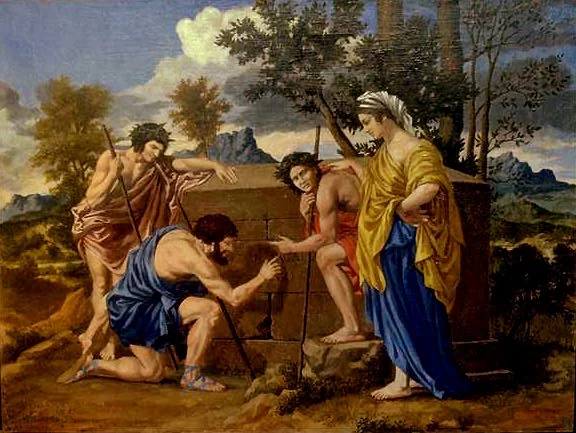
Elegy, Arcadia, Apostrophe
Elegy and Arcadia: the two poles of my imagination, united by the poetic trope of apostrophe: the address to someone or something not there.
The void in the vocative O!
Arcadia is the past, the lost paradise whose imaginary function is inseparable from its pastness, its lostness. But Arcadia, ironized, can also be of the future. And when I think of the future, I think of elegy: seeking after consolation for what has been irretrievably lost.
Francis Ponge, whose collection of prose poems Le parti pris des choses will be published in September in a new translation by myself and Jean-Luc Garneau, accomplished an Arcadia of the present in a series of near-apostrophes to common everyday objects. The oyster, the orange, the cigarette, they may very well have been, probably were, there. But were they, are they, capable of reciprocating the poet's attention, his address? Here's our version of "L'huître":
OYSTER
The oyster, though the size of an average pebble, has a more rugged appearance, with less uniformity to its brilliant whitishness. It is a world obstinately closed. All the same it can be opened: grip it with a rag, use a serrated knife that’s not too sharp, and work at it doggedly. Curious fingers will cut themselves and break their nails; it’s dirty work. The blows administered to the shell sheath it in white circles, sort of like halos.
Inside one finds an entire world to be eaten and drunk, underneath a firmament (to speak precisely) of mother-of-pearl. The heavens above collapse into the heavens below, forming a pond, a viscous little green bag, ebbing and flowing in our smell and sight, fringed with a blackish lace.
On very rare occasions a little phrase pearls in its nacreous throat, which we immediately seize for a decoration.
The oyster is not so much addressed as described, and yet that description contains a kind of deification, a spiritualization achieved paradoxically through Ponge's dry, pseudo-scientific attention to such physical details as the ruggedness of the shell's exterior and the pearliness of its interior. The oyster takes on a spiritual life as it becomes unstable in the poet's eye, shifting unpredictably from object to metaphor and back again. All of Ponge's things are constantly changing into language and back again, and our attitude toward them, as toward language, can be affected by our humanism or merely rapacious, as when we "seize for a decoration" the "little phrase [that] pearls in its nacreous throat."
Ponge's original for "phrase" is "une formule"; my translation as "the little phrase" alludes to the little phrase of Vinteuil's sonata in Swann's Way by Proust, a snatch of music that becomes, for Swann, the metonymic emblem of his passion for Odette. As Proust writes, the phrase changes as Swann listens to it; at first he appreciates "only the material quality of the sounds which those instruments secreted"; then the notes of the phrase "substituted (for his mind's convenience) for the mysterious entity" he began to perceive after hearing it repeatedly; finally it is played, again and again, inexpertly, by the fingers of Odette for Swann's pleasure; it becomes symbolic and debased, just as Odette herself is the debased and inadquate vessel for the finest and strongest emotions that Swann will ever be capable of feeling. She is there; he even marries her; but the marriage itself is a kind of apostrophe or elegy to the dead feelings the real Odette has come to represent.
Everything I write seems to take this form--of course writing itself represents what is not there, presents nothing other than itself. It's been fascinating to write fiction, to tell stories, because it throws into sharper relief language's poetic function. When I write a poem, the language is primary; when I write a story, representation of an imaginary world takes precedence, though the most vivid representations, or images, are those that pull some participatory impulse out of the reader to make them real. Poetry, by comparison, is weirdly self-sufficient, or so it can seem. The reader's encounter with it doesn't complete the poem; if anything, poems are repellent, experiences on the page that fling the reader back out into the moment. They are the absolute opposite of stories, or social media posts; they don't absorb the reader but confront him in vivid strangeness, like Ponge's oyster.
Most readers are impervious to the poem's all-but-mute appeal; it requires a certain perversity (pun intended) to have a taste for language being itself. The rest must be lured by the sop of story, the bones of meaning, as in T.S. Eliot's famous analogy: "The chief use of the 'meaning' of a poem, in the ordinary sense, may be (for here again I am speaking of some kinds of poetry and not all) to satisfy one habit of the reader, to keep his mind diverted and quiet, while the poem does its work upon him: much as the imaginary burglar is always provided with a nice piece of meat for the house-dog."
The words, the apostrophe, are really there: on the page, in your ear. The lost person, or yet-to-be place, cannot be. These are the rules of the game, but they are played differently in poetry, in translation, and in fiction. I am learning these rules. In the new novel that I have just finished, an artificial Arcadia is the scene of elegy: the survivor of a disaster, living in relative comfort, mourns the woman who did not, chose not, to survive with him. He apostrophizes her, addresses her, throughout: she is the muse of the story that he tells of his survival and his community. But unlike Beautiful Soul, Concord is not a poem. It is, I hope, a bit more canny about the poetic difference, even as it exists within the continuum that has so long defined what I write.